
| Categories
...... |
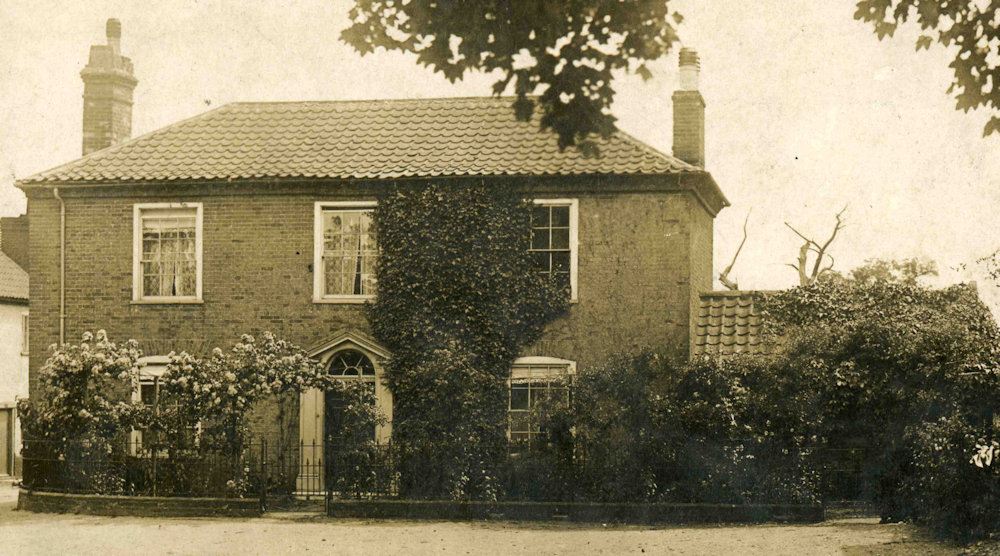
One of the most distinctive properties in Mattishall is Several House which lies due South of the Church and faces straight across the plain it has the air of something out of Jane Austen. The facade appears to be about 1800 (which would have been during the ownership of the Reverend George Smith) but this assessment must be subject to a more 'professional judgement. The present owners, Colonel and Mrs. C. E. Knight, have in their possession a very interesting set of legal and manorial papers about the. house between 1754 and 1920, in which year it was bought by Mr. James Neave. We have not been able to establish how long the name "Several House” has been in use; it is not employed in any of the papers, nor in any of the rate books for 1839-66 which are in the parish chest. Nor. have we found any reliable explanation of the meaning of the name; local surmise would say it is derived from the fact that amongst the many public houses originally in the village "The Bull" was the only one which sold “several” types of ale. More likely however, is the fact the original estate comprised "several" parcels of land. The pivotal date in the documentary history of the house is 1842; in that year the house was conveyed to 'the Reverend Thomas Paddon, Vicar 1821-61, and the Abstract of Title prepared on that occasion not only includes a new modern description of the property which was to be repeated in all the following transactions, but also an older description dating from 1754, viz:
As "The Bull" the house
'was presumably an inn, one of a dozen or more known to have existed
at different times and places in the village; Mattishall Street
is the existing main road, and Churchgate Street what we now call
Church Plain.
The same Abstract lists the owners
between 1754 and 1842:
Thus we have a complete list of the owners right back to 1754, but this is not to say that all or any of them were resident, though it seems most likely that Mr. Smith lived in the house, since he bought it in the year of his marriage. We certainly know, both from the Abstract of Titles and from the excellent series of Poor Rate books 1836-66 in the parish chest. that in the period immediately prior to the auction, it was occupied in. 1836 by Mrs. Brunton (and before that by Williain-Brunton). Colonel Knight has a sale bill which tells us that the house is occupied by Edward Robert Owen, a surgeon. The rate books tell us that he was tenant of the whole property (over 2,acres) from 1837 till after August 1841. (The most interesting rate books for 1839 list addresses, not done in the later books; there are many which come new even to those who have been diligently studying the village history for years. Where are Brazen Doors, Lelderum Square or Frogs Hall? It is evident that Gentleman's Walk was on the North side of the Church. Bull Street will, after further study, perhaps be found in the region of Several House, while the Plain was known as Queen Square). The church registers tell us that Mr. Owen had four children baptised between 1838 and 1842. The house was auctioned by Mr. Spelman on June 2 1841 at the King's Arms in East Dereham. The Lindsey property was in 5 lots. At the auction, the house, Lot 1, was unsold, but Mr. Paddon bought it straight after the sale for £400. At the auction he had already bought Lot 2, an adjoining orchard, for £80. His legal fees to Messrs. C7olden, Browne and Carthew were £18 and his fees payable to the Manor were £60.10.0, including 2s.0d. (10 pence today) for the crier. Mr. Paddon was a great buyer of land; the Methodists accused him of buying up properties which would make suitable chapels, to hinder their work. The year after his death, the rate-books list under his executors a farm of 38 acres, Several House (not under that name) 7 cottages and gardens, 2 houses and a parcel of land. Completion of the conveyance does not seem to have been achieved before Michaelmas 1842, a very long delay even by today's slow standards. However, in January 1842, Dr. Owen had been succeeded as occupier by Surgeon Pitt, described in the conveyance as Vincent Pitt, though we have no other mention of that forename in the registers. As mentioned, Dr. Owen had had tenancy of over 2 acres, but Dr. Pitt had tenancy of only 1 rood 20 perches. Between the rates of April and October 1845, he was succeeded as tenant by Dr. George Taylor, but Dr. Taylor again rented the full 2 acres. He was still tenant in 1866, our last rate book, but by 1887, when his daughter, Charlotte, married R..W. Pitt, a clergyman, he had moved to South Green. Was this Mr. Pitt related to Dr. Pitt of Several House? (A graphic account of the marriage can be found in the Village History pages 26-7). (Note: Dr. Taylor’s tenancy was interrupted. He was tenant 1845-59, and again from 1865; but.1859-65 the occupier was one John Turner, of whom at the moment we have no other information). Mr. Paddon died in 1861, leaving a life interest in the house to his wife. She did not take up residence herself; the rate books reveal that she occupied a house owned by Francis Taylor. Where this house is and whether Francis was related to George remains to be investigated. Following Mrs. Paddon's death in 1885, aged 82, the property passed under Mr. Paddon’s will to Mr. Willoughby Rackham of Middlesex, and in 1891 Mr. Rackham sold it to Mr. Everitt of Oulton Broad. In 1919 Mr. Everitt purchased his manorial enfranchisement from the Manor of Mattishall Tuddenham and its Lord, the Trustees of the late Mr. G. A.. Berney, of Morton Hall, for the not inconsiderable sum of £109. How many contemporary Englishmen realise that feudal dues of this magnitude were still being bought out as recently as 1919? Mr. Everitt also enfranchised at the same time the pair of houses now known as Talbot House and Church Cottage, between the Vicarage and Church Farm, which Mr. Paddon had bought in 1839 and left to Mr. Rackham, subject to Mrs. Paddon’s life interest. In the enfranchisement of 1919, Several House is described thus, as it had been ever since 1842:
The modern history of Several House begins with 1920 when Mr. Everitt sold it to Mr. James Neave. One final reflection on this most fascinating collection of papers is what a boon the house has been for the lawyers. To start off with, the Stewards of the Manor were lawyers, and no doubt much of the manorial fee payment, extracted at every change of owner, found its way to them in fees. Then we remember the massive Lindsey marriage settlement all recopied 40 years later. Then, once Mr. Paddon had purchased the house, he found that his deeds were part of a document belonging to Mr. Ceorge Culyer who had bought the principal agricultural lot at the sale; there had to be a legal agreement between them giving Mr. Paddon a right to view the deeds when he needed to do so. Appended note: The abstract is dated 1857 and describes how the property passed in 1812 from William Wright to Charles Dunham Barrett. William Wright was a surgeon, described by Parson Woodforde as resident in Badley Moor, which in those days extended to the East side of Welgate He was related to the Bodhams at South Green House and he died in 1811. Charles Dunham Barrett is presumably father of a man of identical name, the livery stable keeper who married one of the Lindsey daughters. Old Barrett's executors sold it to William Miles in 1826, and we do know that in 1839 Thomas Newman was tenant of a beer house belonging to Miles. The 1851 Census refers to a Thomas Newman in Welgate. Mr. Miles sold it in 1842 to Wright Wigg, a Dereham man who died in 1856. The abstract was no doubt drawn up as part of the ensuing sale. We know for certain that Mr. Rackham was, at any rate between 1859 and 1865, owner of a cottage in Welgate. His owning both the Welgate property and Several House no doubt explains how the abstract is still in Colonel Knight's hands, although the properties have for many years been in different hands.
|
| Back to History Menu |
| If you are viewing this site
through someone else's browser then refresh here:- http://www.mattishall-village.co.uk |
 |